Mechanics analysis and implementation exercise

Prince of Persia (1989) Level Replica

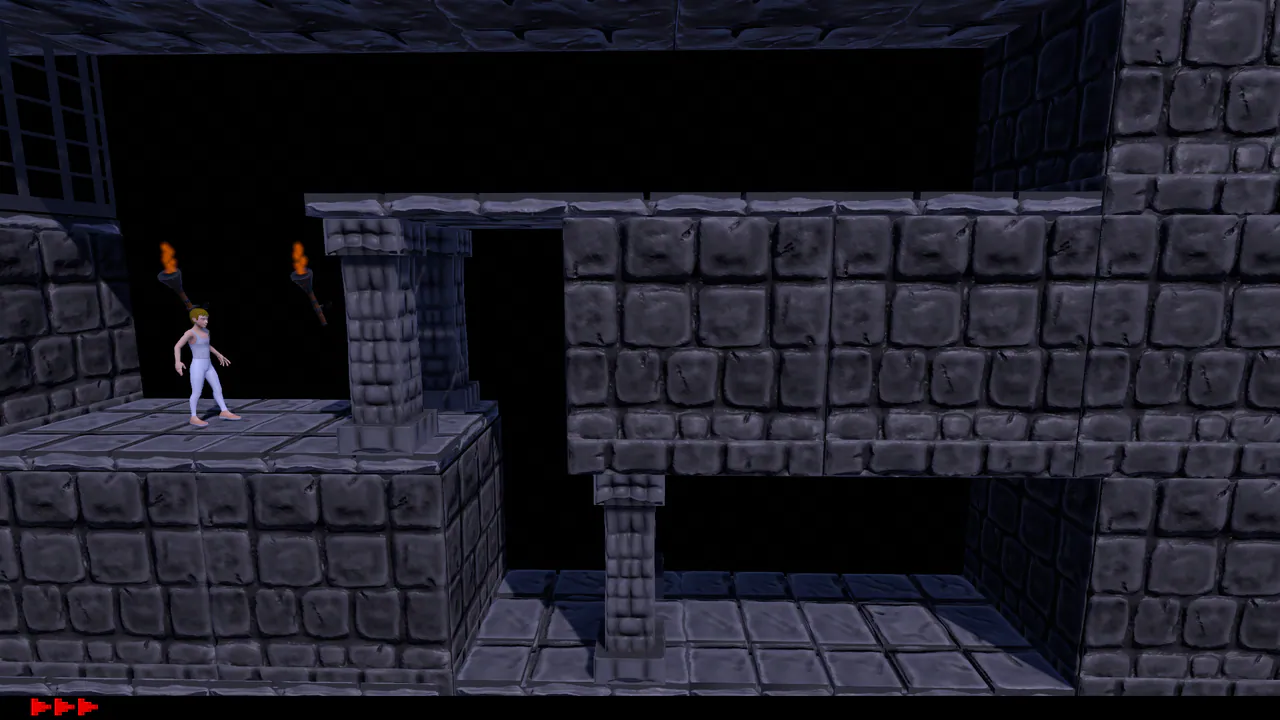
A 3D recreation of the original first level focused on studying movement, pacing, gates, buttons, falling floors, and enemy encounters.

My role
Solo Programmer and Designer
Context
Solo Project · Educational Replica
Period
2023–2024
Status
Released Windows build · source available
  • Unity 2021 LTS
  • C#
  • 3D level design
  • Gameplay scripting
Prince of Persia (1989) educational level replica showing the side-view 3D dungeon layout
A 3D translation of the original level’s side-view pacing and traversal.
Prince of Persia level replica showing the player crossing a bridge beneath a raised gate
A gate-and-bridge sequence from the recreated level.

01 · Overview

Project overview

This project treats an existing classic as a mechanics-analysis problem. The first level was replayed and researched before its interaction rules and pacing were translated into a 3D Unity space.

The public build and source cover the recreated movement, gates, buttons, falling floors and enemy encounters.

This is a non-commercial educational project and is not affiliated with or endorsed by the owners of Prince of Persia.

02 · My role

What I built

  • Studied and replayed the original level to identify its movement rhythm, spatial sequence, and interaction rules.
  • Recreated the first-level structure and its gates, buttons, falling-floor challenges, and enemy encounters in a 3D Unity presentation.
  • Implemented player movement, enemy behaviour, gates, buttons, falling floors, and the playable level sequence.

Project scope

Project-wide capabilities

  • Movement, jumping, side-view framing, gates, buttons, falling floors, traps, enemy attack behaviour, and level pacing.
  • A focused recreation of the first level available as a public Windows build.

03 · Decisions

Project decisions

How the project structured its systems, interactions, and delivery constraints.

Mechanics before embellishment

The exercise prioritised fidelity to the level’s interaction sequence and pacing instead of expanding the original design.

2D reference, 3D implementation

Camera framing and level geometry preserve the original side-view read while using a 3D environment.

04 · Problem solving

Challenges and responses

Concrete constraints are paired with the implementation or design response used in the project.

Challenge

Translating a tightly timed 2D reference into 3D without losing its structure.

Response

Broke the level into mechanic groups and used repeated comparison with the original first-level flow.

05 · Iteration

Testing and iteration

  • Replayed the reference level repeatedly to compare movement, interaction timing, pacing, and encounter placement.
  • Tested the recreated sequence as a complete start-to-finish university exercise.

What I learned

What the project changed

  • Recreating known behaviour makes small timing and camera differences easier to notice and reason about.
  • A compact reference exercise benefits from a narrow scope and clear fidelity target.

Future pass

What I would improve

  • Align the repository documentation with the released mechanics and add an accurate technical breakdown.
  • Add side-by-side footage and document which interactions use code, animation, or scene configuration.

Related work